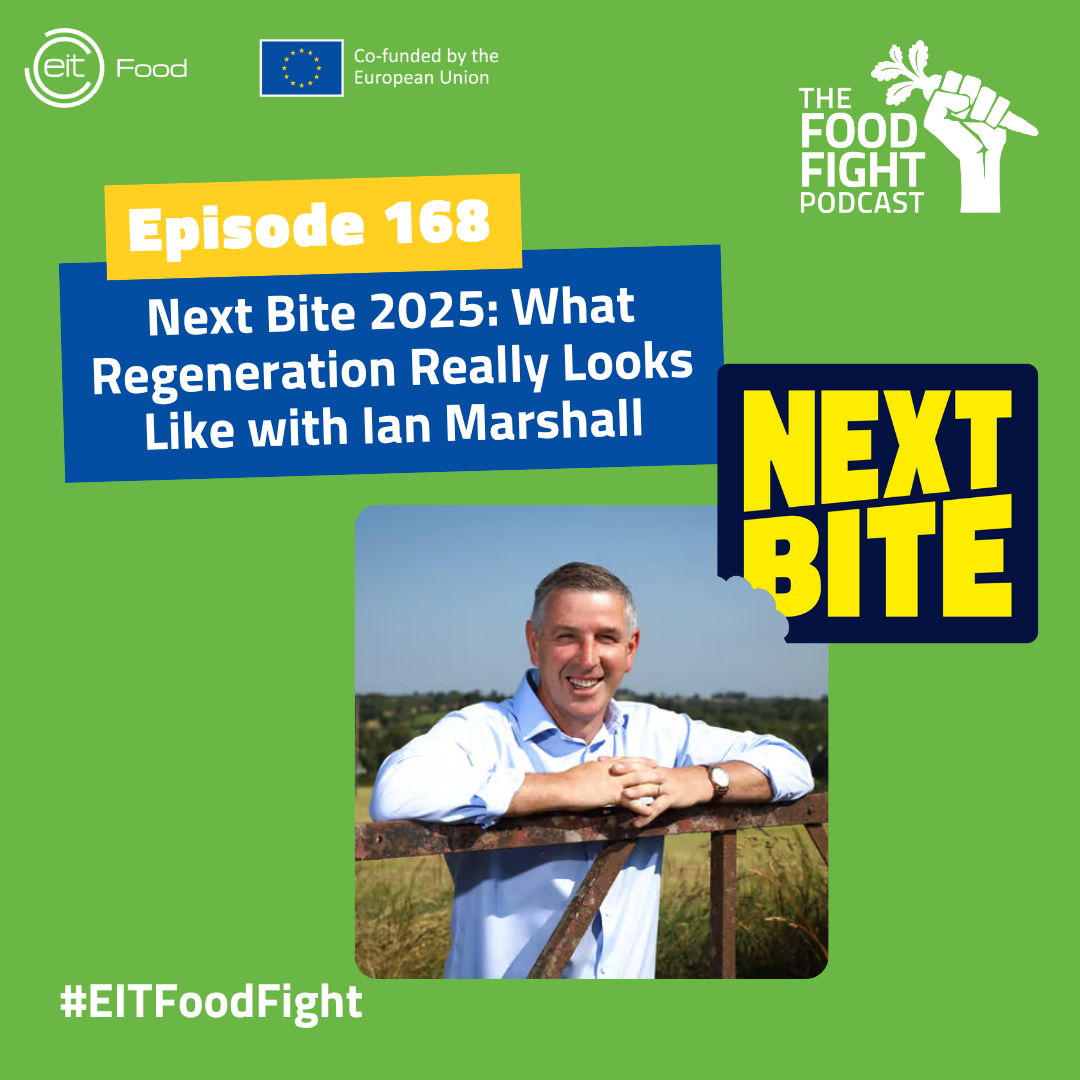
Next Bite 2025: What Regeneration Really Looks Like with Ian Marshall
Forget the buzzwords. Ian Marshall wants to talk about what regenerative agriculture actually means, not just in the soil, but across the entire food system. Speaking at Next Bite 2025, Ian brings the clarity of a farmer, the vision of a policymaker, and the pragmatism of someone who’s spent his career making change from the ground up.
Synopsis
In this special Next Bite 2025 episode of the Food Fight Podcast, our host Matt Eastland sits down with Ian Marshall, farmer, policymaker and long-time advocate for practical change in British agriculture. With years of experience on both sides of the table, Ian offers a rare view into what’s really needed to support a regenerative future, and why that change often starts with listening, not lecturing.
Ian has spent decades navigating the politics, realities and futures of food and farming. In this episode, he lays cuts through the jargon and full and lays out the changes need to turn advocacy into action. Just straight talk about the systems holding agriculture back and the steps we need to take if regeneration is going to be more than a buzzword.
We cover everything from the friction between policy and practice to the slow, often thankless work of building trust between farmers and government. Ian doesn’t claim to have all the answers, but he knows the right questions, and why we need to stop chasing perfect solutions and start backing long-term change.
This epsiode is for anyone who wants to understand how systems shift. It’s about listening to people on the ground, thinking in decades not quarters, and remembering that transformation isn’t just a pipe dream, but something that it’s already happening.
Key Takeaways
1. Regenerative agriculture is often misunderstood by both policymakers and producers
Terms like “regenerative” can feel abstract or imposed when farmers aren’t involved in defining them. Ian stresses the importance of language that reflects farmers’ lived experience and avoids alienating those already working towards sustainability under different names.
2. Trust is built through continuity, not gimmicks
One-off schemes or short-term funding don’t give farmers the confidence to invest in long-term change. Ian argues that true transformation will only happen when there’s policy consistency across political cycles, giving farmers and advisors a clear sense of direction.
3. Farmers need to feel heard, not managed
Ian reflects on how top-down policymaking can undermine farmer agency. He shares that many feel dictated to rather than supported, and stresses the need for co-design in schemes and policies. Farmers should be seen as partners, not passive recipients.
4. Advisory services are stretched thin and lack practical support
Many advisors are working with conflicting priorities. Ian notes the system places too much on them without the proper backing, especially when expected to explain complex policy or shift cultural mindsets without training, resources or time.
5. There’s growing tension between ambition and practicality
Ian points to the mismatch between the goals of ambitious food strategies and the fragmented, on-the-ground reality of farming. Without systems that reflect local nuance and give space for trial and error, the best ideas risk falling flat.
6. Young farmers bring urgency and openness to change
The next generation of farmers are less tied to tradition and more willing to embrace new approaches. Ian highlights this as a real opportunity, but warns that if they don’t see a future in farming - financially or socially - they’ll leave the sector.
7. Policy design must balance environmental aims with economic survival
Farmers can’t engage with sustainability if they’re on the edge of viability. Ian emphasises that support frameworks must consider both environmental targets and income stability, or they risk excluding the very people they need.
8. Change takes time, and that has to be acknowledged
There’s a growing frustration around the pace of change, but Ian cautions against expecting immediate transformation. He urges stakeholders to prioritise depth over speed, acknowledging that genuine systems change unfolds over years, not months.
Listen to the latest Food Fight episodes

The Regeneration Rebellion

AI Eyes On Old Tractors: Can PerPlant Give Farmer Their 25 Good Seasons?
